
How The Challenger simulates boxing, from one punch to a whole world
The ring you box in runs 120 steps a second. The other few hundred fights each month can't. Here's how both engines work, and why the numbers look the way they do.
Two engines, one set of rules
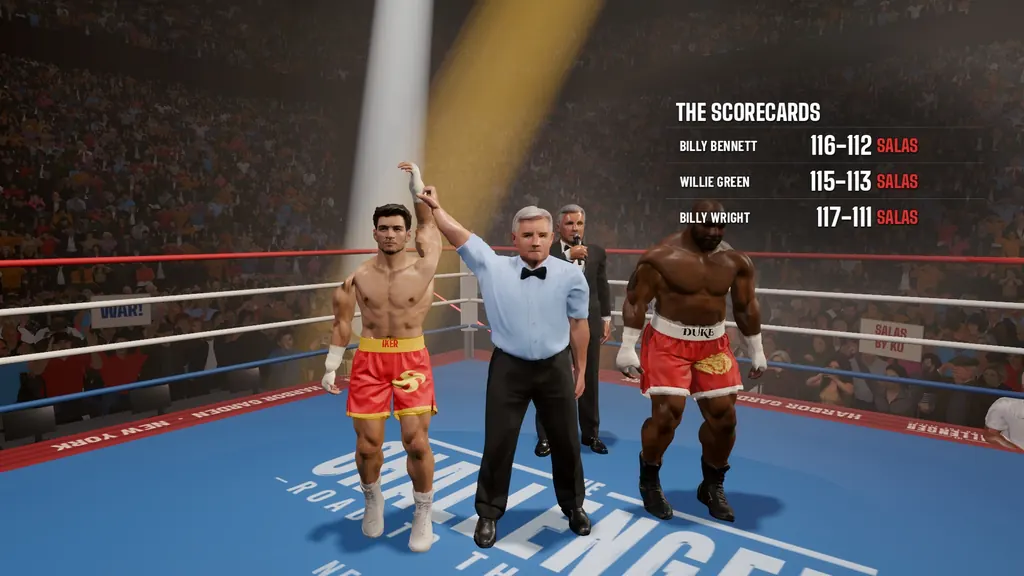
When you box a fight in The Challenger, the ring simulation runs in real time at 120 steps a second: footwork, punches, blocks, gas, damage, the referee, the corners. Every punch has its own speed, reach, damage and gas cost; the guard a boxer uses decides which ones he blocks; a miss leaves him open to the counter. We cover that engine in detail on the fight engine page.
A twelve-round fight takes as long as a real one. That's right for your fights and useless for the rest of the world, where hundreds of fights happen every month across eight divisions.
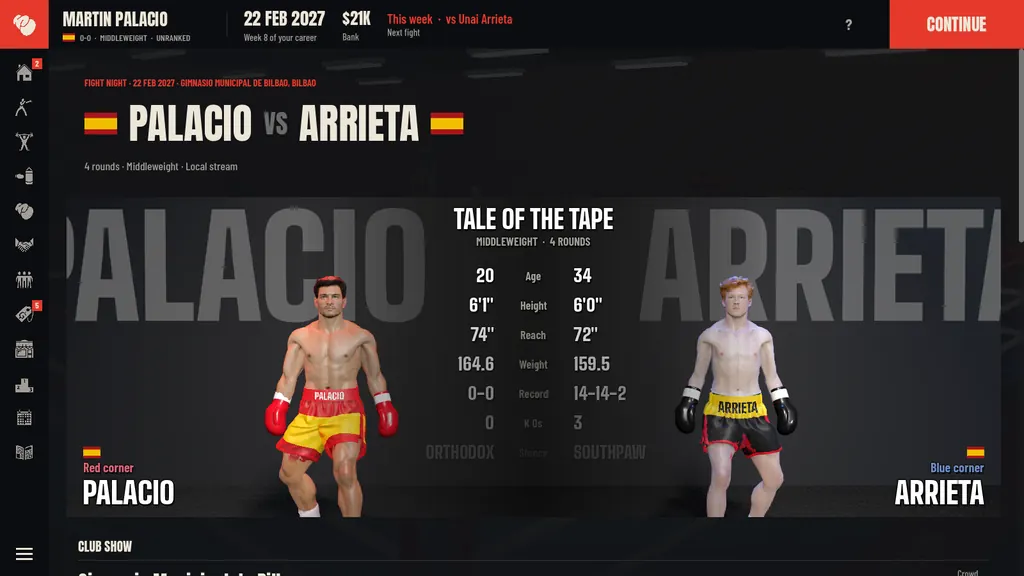
So the career has a second engine: a round-by-round statistical simulation that takes under a millisecond per fight. It doesn't animate anything. It works out punches thrown and landed, damage, fatigue, knockdowns, knockouts, referee stoppages, retirements on the stool, cuts and doctor stoppages (with the accidental-headbutt rules: no decision before the fourth round, to the cards after), point deductions and three judges.
The important part is that both engines use the same ratings and the same ideas. When you choose "Simulate" for one of your own fights, you get the same model the world uses. When you choose "Watch", the ring AI boxes both corners in 3D.
What decides a fight
Every boxer has seven ring ratings (hand speed, power, footwork, ring IQ, chin, stamina, defense) plus three career ones:
- Accuracy makes more punches land and gets past the other man's guard more often.
- Recovery decides how much comes back in the corner between rounds and after getting up from a knockdown.
- Heart decides who gets off the floor, who fires back when hurt, who pushes in the last two rounds when behind on the cards, and whose corner doesn't throw the towel. Heart doesn't win technical fights. It decides wars.
Style matters too, as a loose rock-paper-scissors: a pressure fighter has a small edge on a pure boxer, a boxer on a counter-puncher, and a counter-puncher on a pressure fighter. And every fight in a career adds wear that lowers the ceiling of what a boxer can take from the first bell of the next one.
The fights read each other
Real boxers change what they do based on what's happening. The simulation does the same, using the same thresholds as the ring AI. If the other man threw very little last round (well under his division's pace), especially if he has poor footwork and stands still, a boxer jumps on him: up to two thirds more punches, landing a bit cleaner. If the other man is hurt and he isn't, he throws more. In the last third of a fight of four rounds or more, a boxer two points up on the cards takes fewer risks unless the other man is hurt; one who's behind pushes.
In the ring, the AI goes further. It learns your habits during the fight: throw the same punch too often and it starts reading it, slipping it and leaving a glove where it lands. If you cover up a lot, it switches to the body. And when you're out of gas, hurt or cut, it smells blood: it waits less between attacks, walks you down and adds another power punch to the combination.
Three judges, one of them a little bit local
Every round is scored by three judges. One of them leans slightly towards the home fighter, which is about as much of a home-town decision as the game allows itself. Knockdowns are scored the way they are in real boxing: a round with a knockdown can't come out 10-10. It's 10-8, 10-7 with two knockdowns, or 10-9 if the man who went down clearly won the rest of the round. Scorecards never contradict the result. On fight night, the ring announcer reads them out before naming the winner.
Checking the numbers
We calibrate the world by simulating it for three years, about 1,900 fights, and comparing the results with what real boxing looks like. The latest run:
- About 26% of fights end early: 15% by knockout, 7% by TKO, 3% retirements in the corner and 1% doctor stoppages. The rest go to the cards.
- Between evenly matched boxers, 15 to 17% end early. With a big gap in quality, more than half do.
- Heavyweights stop each other more often than flyweights.
- About 50 punches per round in the middle divisions, with roughly 21% of jabs and 33% of power punches landing.
- The risk of a stoppage grows slowly with the rounds instead of spiking late: between rounds a boxer gets back about half of what he lost.
Getting there took several passes. An early version stopped 55 to 60% of fights, and over 90% of twelve-rounders, because the corner threw the towel based on how a boxer came out for the round rather than how he went back to his stool. That's the kind of thing you only see by running thousands of fights.
The world around the fights
All of this feeds a world that moves a week at a time. Fights are booked eight to twelve weeks ahead. Four sanctioning bodies refresh their top 15 in every division, never rank another body's world champion, name mandatory challengers and strip champions who miss their deadlines. Young boxers improve, veterans decline, the old and the badly beaten retire, and new pros arrive.
The result is a world where your title shot can disappear because the champion lost to a mandatory challenger you'd never looked at, which is exactly how boxing works. You can see how that plays out for your boxer on the career mode page.