
The fight engine
How The Challenger simulates a boxing match: what a punch is, what a guard does, where the gas goes, how cuts open and how a man goes down. Everything here is in the game today.
Simulated, not scripted
A fight in The Challenger runs in real time at 120 steps a second. Each boxer has the height and reach of his own body, so a heavyweight stands a head taller than a flyweight, and seven ratings (hand speed, power, footwork, ring IQ, chin, stamina and defense) change how he moves and punches. Nothing is decided in advance: who lands, who tires and who goes down comes out of what the two of them do.
The bodies are measured from each 3D model, so the fighters touch without passing through each other, in the clinch too. Some timings come from real fights: the jab and the cross were measured from broadcast footage of professional bouts and the engine was adjusted to match.
Seven punches
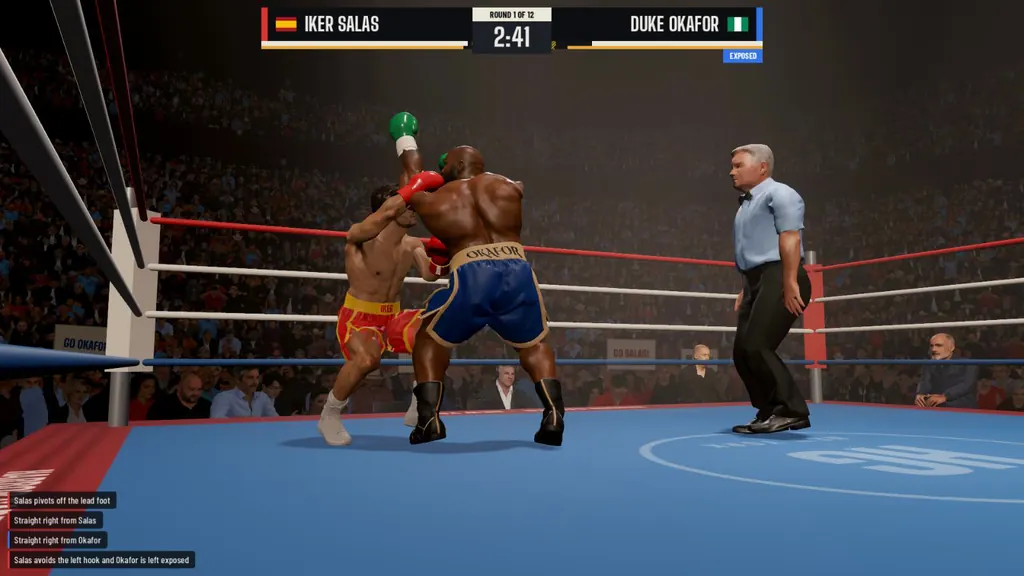
The jab, the cross, the lead and rear hooks, the lead and rear uppercuts and the overhand (for the boxers who throw it), most of which can go to the head or the body. They're not the same punch with different animations: each has its own duration, reach, damage and gas cost. The jab is quick and cheap; the overhand is the slowest and heaviest; a miss with any power punch leaves you open.
Punches move the man they hit. A hook turns his head, a straight or an uppercut lifts his chin, a body shot folds him over, and a clean power punch can loosen his legs for a moment and push him back, so he has to take a step to keep his balance.
Guards and defense
Every boxer fights from one of four guards, and each covers some punches better than others:
- High guard: solid against straight punches and hooks.
- Philly shell: good against straight punches, open to the rear hook and the overhand.
- Peek-a-boo: built for slipping and ducking, weak against the uppercut.
- Hands low: blocks less, but moves the head and feet more and counters more.
When you're in control you can cover up, drop the elbows to protect the body (which leaves the head open), slip left or right, duck, pull back and clinch. Boxers whose body gets worked learn to drop their elbows and block more downstairs.
Gas
Gas is the resource every fight turns on. Every punch costs some; a missed jab costs 1.7 times what a landed one does, a missed power punch about 2.5 times. Taking punches costs gas too, and body shots cost far more than head shots. While you keep throwing you barely recover: you get your breath back when you stop.
Below a certain level the hands start to come down, a little at a time, and a man who misses and is left hanging drops them too. And neither gas nor health ever comes all the way back: the ceiling on both drops with every round and with the damage taken, so a hard fight gets harder as it goes.
Counters and combinations
A man who misses a power punch is exposed for a moment. Hit him then and the counter lands harder, with no glove in the way. The chance of a knockdown from a clean power punch is almost nil when a man is fresh and grows as his health and gas drop, and more so on the counter.
Combinations build: every clean punch that lands within a fraction of a second of the one before hits harder than the last, the second 8% more, up to 32%. A punch blocked or missed, or a clean one taken, ends the run.
Styles and footwork
Three styles fight in different ways. Boxers prefer the outside and get out of range after their combinations. Pressure fighters stay close and walk you down. Counterpunchers throw least and wait for you to open up. Styles interact: a pressure fighter has a slight edge on a boxer, a boxer on a counterpuncher, a counterpuncher on a pressure fighter.
The feet change intention every few seconds (press, hold the center, get out, circle), so sometimes both men come forward and sometimes both hold. Footwork can be automatic, driven by the boxer's rating, or yours to control.
An AI that reads the fight
The computer changes its plan with what's happening, against you and against other computer boxers:
- Throw the same punch too often and it starts to see it coming: it reads it earlier, slips it and leaves a glove where it lands. Stop throwing it and it forgets.
- Cover up or slip a lot and it switches from the head to the body.
- When you're tired, hurt or cut, it smells blood: it attacks sooner, walks you down and adds another power punch to the combination. Smarter fighters read it better.
- Stop punching and it jumps on you. In the late rounds, a man ahead on the cards boxes and takes fewer risks; one behind presses.
- If it's hurt itself, it holds or gets out depending on its heart.
Five difficulty levels decide how much it attacks, how well it reads you and how fast it punishes you when you tire.
Cuts and swelling
The face is divided into zones (brows, eyes, cheeks, nose and lip) and each marks separately. Hooks land on the cheekbone, eye and brow on their side; straight punches on the nose, lip and brows; uppercuts on the lip and nose; the overhand on the brow. Swelling and bruising build with every clean punch to a zone. Cuts open more easily with hard punches, hooks and overhands, swelling and old scar tissue, and an open cut grows with every punch that finds it.
Damage changes the fight. An eye that closes, or one with blood in it, sees punches late on that side, and the other man notices and goes after it. Between rounds the cutman works on the damage; if a cut gets bad enough the doctor can stop it, and accidental headbutts follow the real rules (no contest before the fourth round, technical decision after).
Knockdowns
How a man falls depends on what put him there: a body shot drops him to a knee or all fours, a hook drops him sideways, an uppercut or straight sends him back or sits him down, a man out cold falls stiff. There are 16 falls and 10 ways of getting up, chosen to fit where he lands, including against the ropes.
The referee sends the other man to a neutral corner and counts beside the fallen man's head. If it's you, you get up by hammering the punch buttons: between 12 and 50 presses depending on your gas, the damage you've taken, earlier knockdowns and your heart. A man can also be knocked out cold, and then there's no count.
The corner and the judges
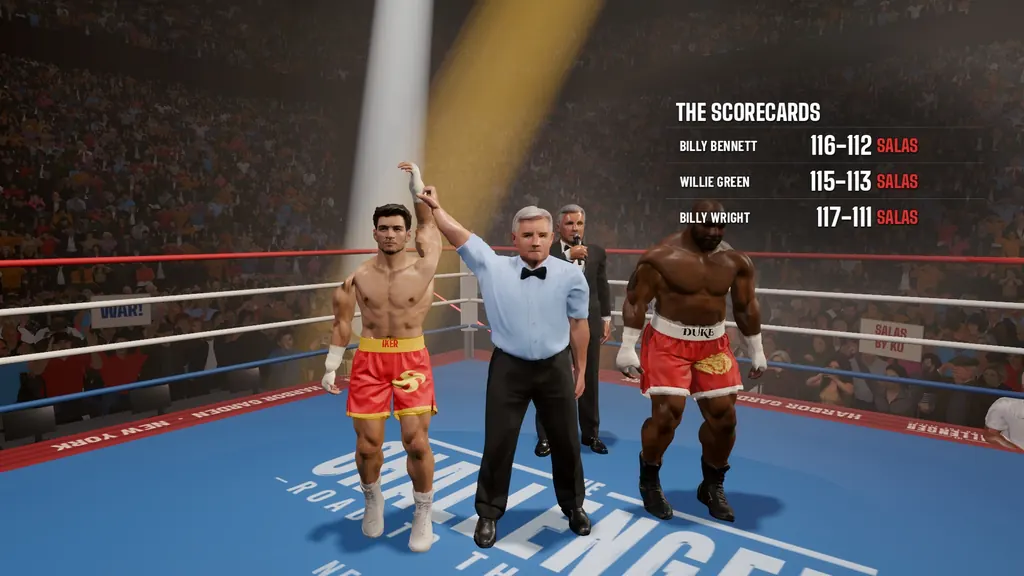
Between rounds your trainer gives you short, specific advice from this fight: the punch of his that's landing most, whether he's holding or waiting to counter, your cut, your gas, where you stand on the cards. Three judges score every round, knockdowns are scored as in real boxing, and the ring announcer reads the cards. Fights end every way real ones do: decisions, draws, KO, TKO, doctor stoppages, retirements on the stool, technical decisions and no contests.
Every fight in the career mode can be boxed with this engine, watched with the AI boxing both corners, or simulated in under a second. How the quick simulation works.
Get notified at launch
One email when the Steam page opens, one at launch, and the odd update. Your address isn't used for anything else. Privacy