
The boxing career mode, in detail
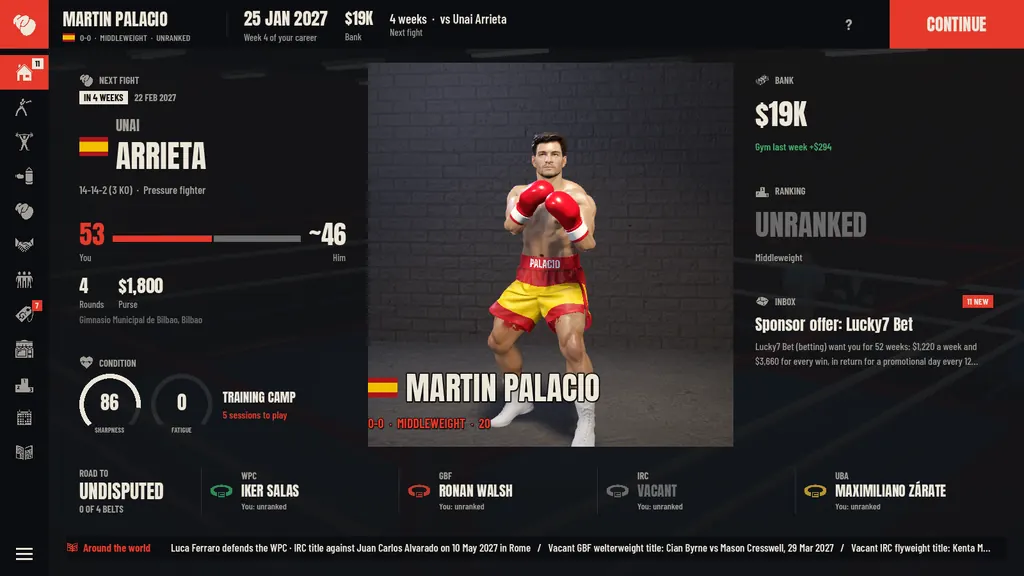
The fights are the heart of The Challenger (see the fight engine). Around them is a deep, realistic career. This is what you do between the first bell of it and the last: the world you box in, the gym you build, the camps you run, the weeks before a fight and what the fights leave behind.
A world that moves without you
Eight divisions, from flyweight to heavyweight, with about 45 active boxers in each: roughly 380 in all. Four fictional sanctioning bodies, the WPC, GBF, IRC and UBA, have a belt in every division, a top-15 ranking, a mandatory challenger and a deadline to defend. Champions who don't defend get stripped. There are unifications, vacant titles and eliminators.
Ten promoters run the business, each with its own TV network, a sanctioning body it gets on with, a level of honesty and its rivalries. More than a hundred venues around the world host the fights, from a neighborhood gym for 300 people to bullrings and football stadiums.
The calendar moves a week at a time. Each week the world books fights eight to twelve weeks ahead, settles the ones on that week's cards, updates the rankings, heals injuries, improves the young, slows down the veterans, retires the old and the badly beaten, and brings in new pros. A newspaper reports on it.
You don't see anyone else's ratings. You get your manager's read on an opponent, which is only as good as your manager.
Your boxer
Create a boxer in seven steps (weight, face, body, trunks, boots, gloves, then name, nickname, country, stance, style and amateur background), or take over one of the game's star boxers with his record, belts and promoter. Boxers you made in the editor can start a career too, with the ratings you gave them.
Every boxer has seven ring ratings (hand speed, power, footwork, ring IQ, chin, stamina and defense) plus accuracy, recovery and heart. Under those sit hidden ones: discipline, mentality, sacrifice and intelligence, and personality traits nobody tells you about. You find out what kind of fighter he is the way a trainer would, by watching what he does when the week goes wrong.
Custom boxers and your own world
Everything you make in the editor can go into a career. Create custom boxers with a face from a photo, edit the game's own boxers, and set up each division: its members in ranking order, the champion of each of the four belts, and how many generated pros fill the rest (or let the editor fill it for you, and see them before you start). Choose "My world" when you start a career and that's the world you box in; after that, your boxers age, improve, decline and retire like everyone else.

Gym, team and money
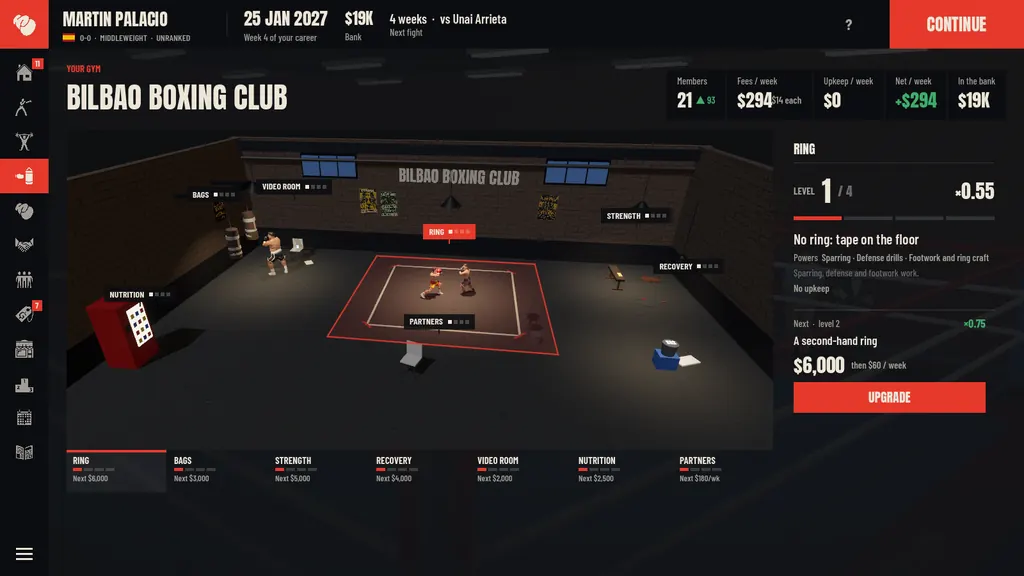
You start in a terrible gym in your own city: no ring, two broken bags, a rusty bench and a bucket of ice. You upgrade the ring, bags, strength room, recovery, video room, nutrition and sparring partners, four levels each. Better facilities make their sessions count for more and cost more every week; gym members pay fees, and more of them come as the gym and your name grow.
Your team is a trainer, a cutman, a conditioning coach and a manager. Each takes a cut of your purse, and the good ones only work with boxers who have a name. Staff from your own country cost less.
Three sponsor slots pay weekly and per win, and take promotion days out of your camp. Betting and alcohol brands pay more and cost you image. The shop sells gloves, boots, trunks, lettering, designs, tattoos and robes. Run out of money with no fight signed and you have four weeks before the career ends in bankruptcy.
Training camp and weight
A week is five training sessions chosen from twelve kinds of work plus press and rest. Every kind of session can be played once a week as a drill (the hill run, the lifts, the pads, the double-end bag, yoga and more), graded from F to A+. A good grade makes that session count for more for the rest of camp and can lift a rating or two on fight night. If you don't play it, your trainer runs it.
You can also hand your weeks to your manager or trainer, plan the camp week by week, or skip straight to fight week.
Your weight moves with what you eat and how you train, and your natural weight rises with age. Diets range from eating normally to not eating at all, which takes weight off fast and strength off for good. If you come in heavy in fight week, you choose how to lose it: the sauna, an extreme cut that can leave you on the floor on the way to the scales, banned diuretics, or coming in over and paying for it.
There are shortcuts too: dubious supplements, a steroid cycle, EPO. They work, and there are tests after every fight and at random. Get caught and you lose the result, the belts, the money and months or years of your career.
Life between fights
Things happen. In camp, and in the weeks off, the game throws up 48 different situations: a party, a legend dropping by the gym, a sparring partner who wants a war, midnight cravings, a video from the other camp, family. They change with your fame, from the local paper and selling your own tickets to TV interviews, a fan club and a drug tester at six in the morning. Each choice has a price, and some quietly test your hidden ratings. Win often enough and the press may hand you a nickname.
Fight week
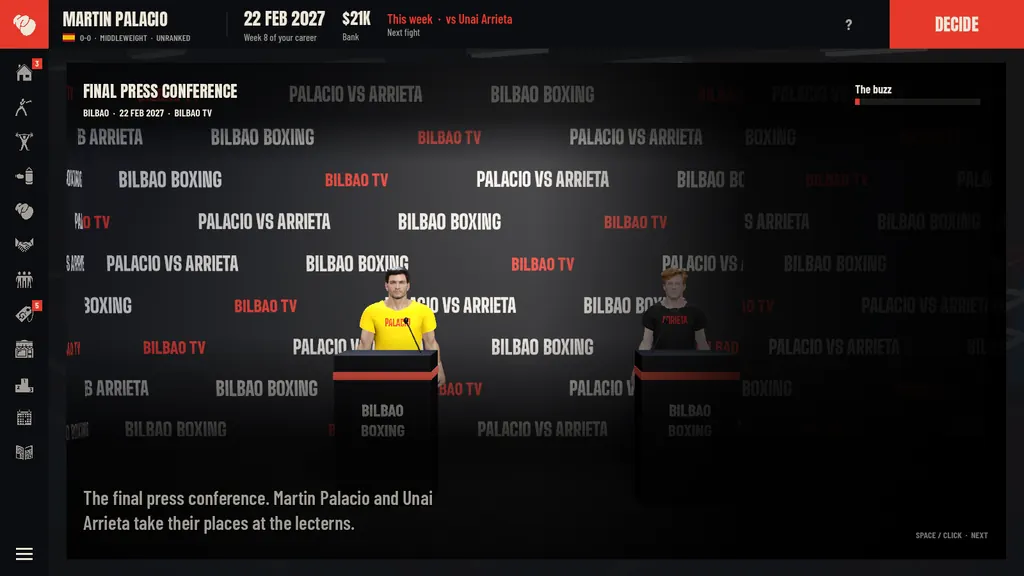
Fights of eight rounds or more, title fights and fights once you're known come with a press conference. The questions are about the fight, and your answers matter. Before the bigger ones there's a war of words with your opponent, then the weigh-in, a stare-down you can lose and a handshake you can offer or refuse.
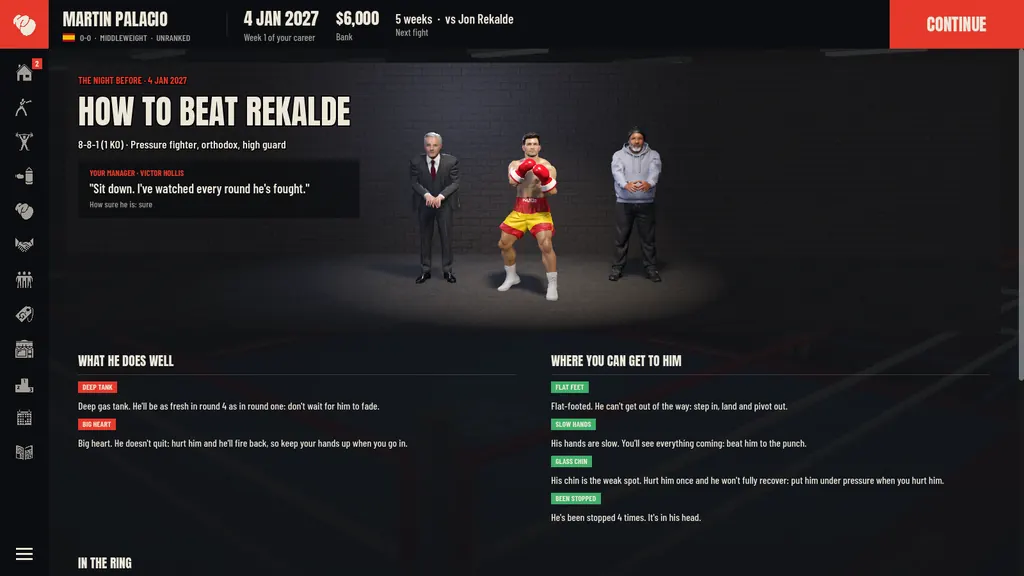
The night before, your trainer sits down with you and goes through what the other man does well and where you can get to him. The plan you agree on changes how your boxer fights, whether you box the fight yourself or let the AI do it.
Fight night
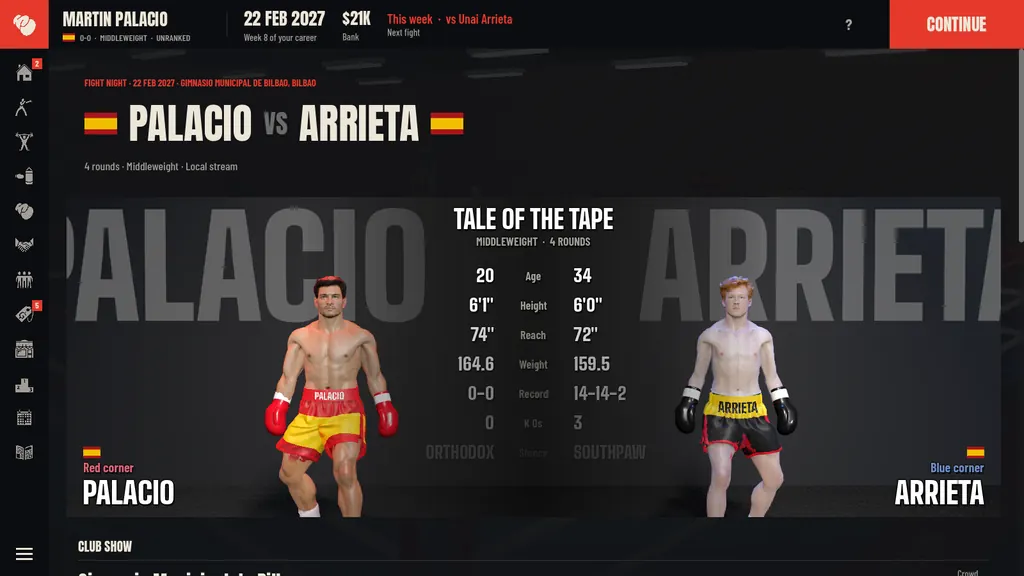
Where you fight depends on the money and on who promotes it. Champions host; home crowds matter; Mexico City's altitude gets to the visitor, and a huge crowd against you weighs on a fighter with little heart. The night opens like a TV broadcast, with the ring walk, anthems, introductions and the tale of the tape, and then you choose: box it, watch it, or simulate it.
What fights leave behind
Medical suspensions after every fight, longer after a knockout. Cuts that need stitches, closed eyes, broken noses and hands, ribs, concussions and scar tissue that opens again. You choose the recovery plan, and training through an injury risks making it worse. Every fight adds wear that lowers what your boxer can take from the first bell of the next one, and age does the rest.
The goal is undisputed: all four belts of your division at the same time. The first time you get there, the credits roll with your name on the title card. Then the career carries on, if you want it to.
Planned: an online mode. More details as development goes on.
Want to know how the numbers behind all this work? Read how The Challenger simulates boxing, or see how it compares in our guide to boxing games with a career mode on PC.
Get notified at launch
One email when the Steam page opens, one at launch, and the odd update. Your address isn't used for anything else. Privacy